




Silica gel desiccant works in packages by taking water from the air and keeping it inside. You may not know this, but water can harm products when they are shipped or stored. Each year, about 10% of $500 billion in goods get hurt because of water. Silica gel desiccant helps keep your things safe in an easy way:
It catches water and keeps stuff dry.
Its small holes let it hold up to 40% of its own weight in water.
It stops rust, mold, and spoilage better than other desiccants.
Have you ever thought about how a tiny packet can help so much? The science in silica gel makes it a strong guard for your things.
Key Takeaways
Silica gel desiccant takes in water from the air. This helps keep products safe from water damage when they are shipped or stored. Each silica gel bead has a big surface area. It can hold up to 40% of its own weight in water. This makes it work very well. Silica gel stops mold, rust, and spoilage. It helps food, electronics, and medicines stay safe and fresh. You can use silica gel packets again. Heat them to get rid of the water inside. This saves money and cuts down on waste. Silica gel is not poisonous. It is safe to use with food and electronics. But you should always look for harmful signs like cobalt chloride. Keep silica gel packets in their packages until you need them. This helps them work better to control moisture. Silica gel packets can be used in many things. You find them in food, clothes, and medicines. They help these items last longer. Throw away used silica gel packets the right way. Follow your local rules. You can also look for green choices to control moisture.
How Silica Gel Desiccant Works
Moisture Adsorption Process
Pores and Surface Area
You might ask how silica gel desiccant holds so much water. The answer is in its tiny pores and big surface area. Each bead has a surface area as large as a football field. That is packed into something as small as a sugar cube! These pores give water many places to stick. More surface area means more water gets trapped.
Silica gel has lots of space for water to cling.
The tiny holes let air pass through, so water can get inside.
Silanol groups on the surface help hold water by making hydrogen bonds.
Property | Description |
|---|---|
Structure | Porous structure with a high surface area (up to 800 m²/g) |
Mechanism | Adsorbs moisture via physical, non-reactive adsorption |
Effectiveness Range | Inert and effective across a wide relative humidity (RH) range (20–60%) |
Capillary Condensation
The pores do more than just give space. They also help with capillary condensation. This means water vapor turns into liquid inside the tiny holes. First, a thin layer of water forms on the surface. Then, more layers build up until the pores are full. This lets silica gel desiccant hold even more water.
Capillary condensation lets liquid form inside the pores, so more water is caught.
Mesopores fill with condensed vapor, so the beads hold extra water.
It starts with one layer, then more layers form, ending with full condensation.
Inside Packaging
Trapping Water Molecules
When you open a box and see a small packet, it is a strong moisture trap. Silica gel desiccant grabs water from the air inside the package. The beads make strong bonds with water and lock it away. This lowers the humidity and keeps things dry and safe.
Silica beads make strong bonds with water in the air.
The big surface area and pores help trap a lot of water.
This lowers humidity in a closed space.
Preventing Humidity Damage
You want your things to arrive fresh and safe. Silica gel desiccant helps by soaking up water vapor and keeping humidity low. This stops mold, rust, and spoilage before they start. In sealed packages, the desiccant pulls in leftover water, protecting items that do not like moisture. Electronics, food, and medicine stay safe because the packet keeps the air dry.
Tip: If you find a silica gel packet in new shoes or snacks, do not throw it away. It is working hard to keep your things safe from water!
What Is Silica Gel?
Composition and Structure
Amorphous Silicon Dioxide
Silica gel keeps things dry because of what it is made of. It is made from silicon dioxide, which is also in sand. But silica gel is not like sand because its atoms are not in straight lines. The atoms are mixed up in a random way. This makes lots of tiny holes inside. These holes give silica gel a huge surface area. That is why it can grab and hold water so well.
Silica gel is hydrated silicon dioxide (SiO₂·nH₂O). It can soak up water because it has many connected pores. These pores are between 3 and 60 angstroms wide. The surface area is between 300 and 800 square meters for each gram. That is like having a football field in just a few beads!
Here is what makes silica gel special:
The random structure gives it a big surface area.
Connected pores help it take in water.
The three-dimensional shape has silanol groups that trap water.
Why It’s Called a Gel
You might think “gel” means it is soft or wet. Silica gel is not soft and it is not wet. The name comes from how it is made. First, a chemical reaction makes a jelly-like stuff. Then, it is dried until it is hard and glassy. Even though it feels like small beads, the name “gel” stayed because of how it started.
Why Use Silica Gel Desiccant
Advantages Over Other Desiccants
Manufacturers use silica gel desiccant for many reasons. It controls moisture well in many places. Silica gel works in both low and high humidity. It can hold 30–40% of its own weight in water. This is more than clay desiccants and almost as much as molecular sieves. You can also reuse silica gel by heating it to remove the water.
Desiccant Type | Adsorption Capacity (at 50% RH, 25°C) |
|---|---|
Silica Gel | ≈ 30% of its own weight |
Clay Desiccant | ≈ 25% of its own weight |
Molecular Sieve | ≈ 20% of its own weight |
Silica gel works well in both dry and damp air. You can trust it to keep your things safe.
Non-Toxic and Inert
It is important to pick a safe desiccant. Silica gel is non-toxic and does not cause rust. It will not react with your things or hurt them. It is safe to use with food, electronics, and medicine. You can touch it without special gloves, and it does not make a mess.
Moisture Adsorption Details
Adsorption vs. Absorption
Key Differences
You might wonder what makes adsorption different from absorption. These two words sound similar, but they work in very different ways. When you use silica gel desiccant, you deal with adsorption, not absorption. Here’s a simple table to help you see the difference:
Process | Description |
|---|---|
Absorption | Particles move inside the whole material. The material soaks up water throughout its bulk. |
Adsorption | Particles stick to the surface only. The material grabs water on its outer layer. |
Silica gel grabs water on its surface. It does not soak it up inside like a sponge. This makes silica gel very good at catching water vapor quickly and keeping your things dry.
Capacity and Saturation
How Much Moisture It Holds
You may ask, “How much water can a silica gel packet really hold?” The answer might surprise you. Silica gel packets can adsorb up to 40% of their own weight in moisture. That means a small packet can trap a lot of water vapor from the air around your products.
The amount of water held depends on temperature and humidity.
Different types of silica gel may hold more or less water.
Silica gel works best in sealed packages where it can control the air.
If you see a packet inside a box, it’s working hard to keep your items safe from moisture.
Reactivation by Heating
When silica gel gets full, you don’t have to throw it away. You can reactivate it and use it again. Here’s how you do it:
Heat the saturated silica gel for 4-6 hours at 105-110°C. This removes almost all the moisture.
Use a ventilated electric oven. Avoid sealed or gas ovens for safety.
Don’t use devices that change the activity indicator to blue during heating.
After heating, cool the silica gel in a sealed container. This keeps it from picking up water again.
If you have a lot of silica gel, use equipment that can handle up to 25 kilograms.
Check the weight before and after heating to make sure it’s dry.
Make sure there’s enough airflow—at least 5-10 cubic feet per minute—for the best results.
Tip: You can reuse silica gel many times if you follow these steps. This saves money and helps protect your things again and again.
Protecting Products from Moisture
Common Moisture Problems
Mold and Corrosion
Moisture can get inside packages and cause problems. Mold grows on shoes, clothes, and food when it is damp. Mold spreads quickly and likes wet places. Corrosion happens when metal parts touch water. Rust forms on metal, and electronics can break. Moisture can make electronics stop working by causing short circuits.
Too much moisture helps mold and mildew grow. Mold can show up on food, paper, and fabrics. Mold makes things smell bad and look dirty. It can also make people sick.
Electronics can break if moisture gets inside. Devices may stop working or metal parts may rust. Moisture can ruin gadgets and make them unsafe.
Food and Electronics Damage
You want your snacks to stay crunchy and your devices to work. Moisture can make snacks soggy and stale. Powders can stick together and not pour well. Electronics can have bigger problems. Moisture can cause short circuits and hurt small parts.
Here is a table showing common moisture problems in packages:
Problem | Explanation |
|---|---|
Caking & Clumping in Powders | Powders pull in water and stick together. This makes them hard to use. |
Soggy or Stale Snacks | Water makes snacks soft and not crunchy. |
Mold & Bacterial Growth in Dried Foods | High humidity lets mold and bacteria grow. This spoils food and makes it smell bad. |
Silica Gel Desiccant Benefits
Extending Product Life
You want your things to last and stay fresh. Silica gel desiccant helps by taking water from the air. It keeps packages dry and safe. This packet protects food, electronics, and medicine from harm.
Silica gel desiccant grabs extra water. It keeps dry foods, spices, and dried meats tasty.
It protects medicine from water. Tablets and powders stay strong and work well.
Electronics stay safe because silica gel desiccant stops rust and short circuits.
Tip: If you see a packet in new shoes or gadgets, keep it in the box. It helps your things last longer!
Silica gel desiccant works by pulling water onto its surface. Its tiny holes trap water and lower humidity. This keeps products safe when shipped or stored. You can trust it to protect electronics and medicine. It helps stop mold, rust, and spoilage so your things stay nice.
Applications in Packaging
Products That Use Silica Gel Desiccant
Electronics and Pharmaceuticals
You see silica gel packets in many packages, but do you know why? Electronics and medicines need extra protection from moisture. If water gets inside, it can ruin a phone or make pills break down. You find these packets in boxes with headphones, cameras, and mobile phones. Medicine bottles and tablet packs also use them to keep pills dry and safe.
Electronics: Headphones, mobile phones, cameras, and laptops stay safe from humidity.
Pharmaceuticals: Tablets, capsules, and vitamins keep their strength and shape.
Food, Clothing, and More
Silica gel packets help in other products too. Food companies use them to keep snacks crunchy and powders free-flowing. Clothing brands add them to shoe boxes and bags to stop mold and odors. You might spot these packets in snack packs, spice jars, or even new purses.
Food Industry: Snack packs, dried fruits, spices, and powdered drinks stay fresh.
Clothing: Shoes, bags, and leather goods avoid mold and bad smells.
Other: Collectibles, documents, and camera gear stay dry during shipping.
Packet Types and Sizes
Choosing the Right Amount
You might wonder how companies pick the right silica gel packets for each package. They look at the product, the package, and how much moisture needs to be controlled. Here’s how they do it:
Check if your product is sensitive to moisture.
Look at how much air can get through the packaging.
Measure the humidity inside the package.
Figure out how much water needs to be absorbed.
Pick the best type of packet for your needs.
Test in real life to make sure it works.
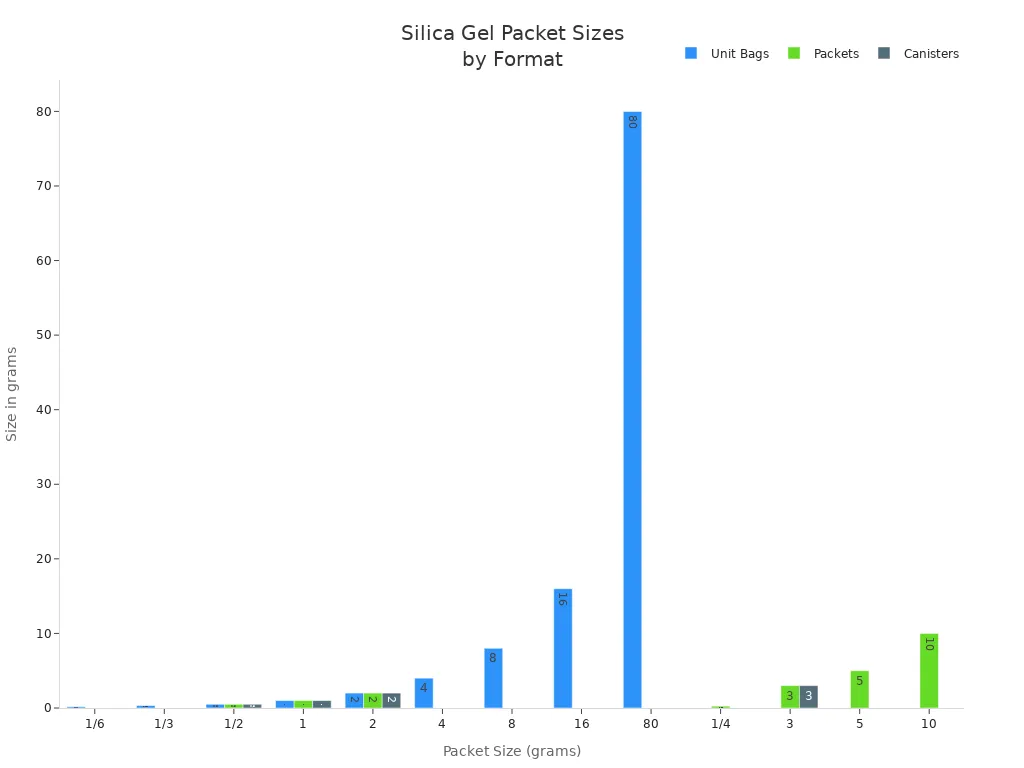
Manufacturers use different packet types and sizes to fit every need. You see tiny packets in pill bottles and bigger ones in electronics boxes. Some packets come in strips, while others are packed in canisters or sewn cloth bags.
Packet Type | Size Range (grams) | Formats Available |
|---|---|---|
Packaged Desiccants | 0.25g to 2,500g | Tyvek, Non-Woven, Performance Dry® Wrap, Clear Film, Sewn Cloth, Re-enforced Paper |
Small Size | Continuous strip or individual cut | – |
HDPE Canisters | 1.0g to 3.0g | – |
Packet Type | Standard Sizes (grams) | Description |
|---|---|---|
Unit Bags | 1/6, 1/3, 1/2, 1, 2, 4, 8, 16, 80 units | One unit is about one ounce of desiccant material |
Packets | 1/4, 1/2, 1, 2, 3, 5, 10 | – |
Canisters | 1/2, 1, 2, 3 | – |
Tip: Always keep silica gel packets in the package until you use the product. They work best when left inside.
Silica gel desiccant gives you flexible options for every kind of package. You can choose the right size and format to keep your products safe and dry.
Safety and Disposal
Is Silica Gel Safe?
Handling and Ingestion
You see silica gel packets in many packages. Most white silica gel is not toxic. You can touch it, but do not breathe the dust. Some packets have blue beads. Blue-indicating silica gel has cobalt chloride. This chemical is harmful and can make you sick. Orange-indicating silica gel is safer. It is used in food packaging.
Here are some safety tips for silica gel:
White silica gel is safe for most things.
Blue silica gel has cobalt chloride. Be extra careful.
Orange silica gel is better for food and sensitive items.
Small packets can choke kids or pets.
Silica gel dust can bother your nose and throat. Wear gloves and work with good airflow.
Keep packets in a cool, dry place. Keep them away from children and animals.
If you swallow silica gel, do not worry too much. Silica gel is not poisonous. The main danger is choking or a mild stomach ache. Eating a lot can dry you out or block your stomach. If the packet has cobalt chloride, you may feel sick.
Tip: Always look at the packet label. If you see blue beads, keep them away from food and kids.
Effectiveness Over Time
Shelf Life and Reactivation
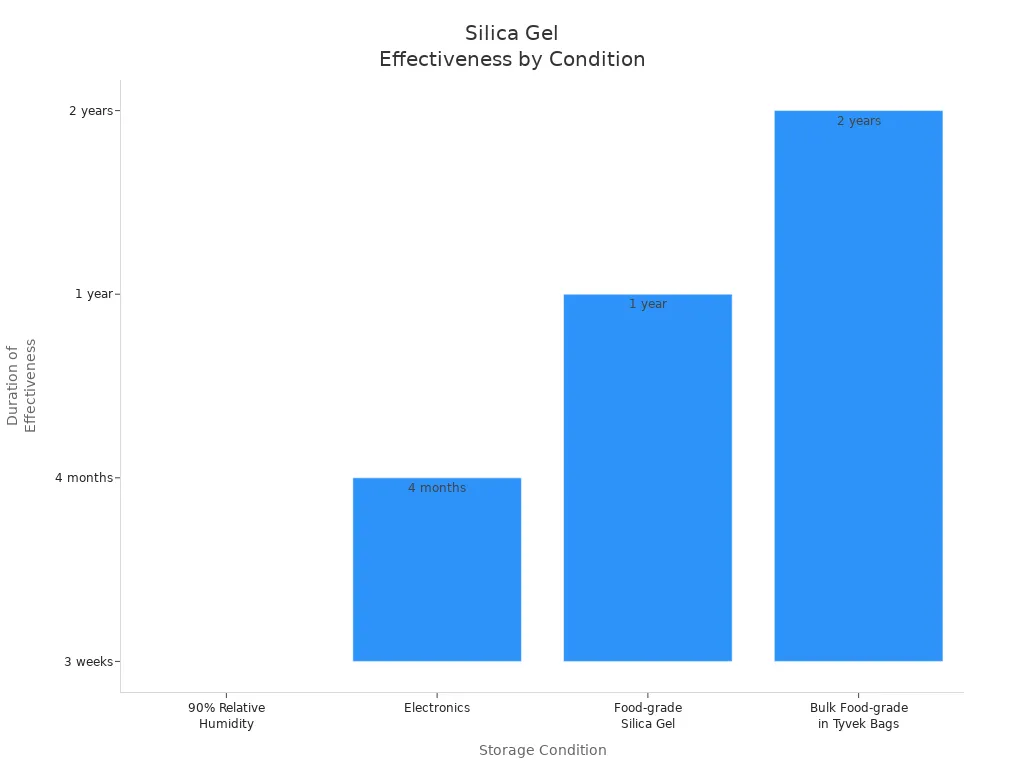
Silica gel does not work forever. It slowly fills up with water and stops working well. How long it lasts depends on where you use it. In wet places, silica gel gets full in a few weeks. Electronics need new packets every few months. Food-grade silica gel lasts about a year. Big Tyvek bags can last more than two years.
Condition | Duration of Effectiveness |
|---|---|
90% Relative Humidity | Saturated in 3 weeks |
Electronics | Replace every 4 months |
Food-grade Silica Gel | Replace annually |
Bulk Food-grade in Tyvek Bags | Lasts over 2 years |
You can dry out silica gel by heating it in an oven. This makes the beads ready to use again. Cool the beads in a sealed container so they do not get wet from the air.
Disposal and Environment
Eco-Friendly Options
When you finish using silica gel, throw it away the right way. Follow your local trash rules. Some packets, like Ecobag, can go in compost. Others go in regular trash.
Eco-friendly choices are getting popular. You can use activated charcoal, rice, baking soda, or cat litter to keep things dry. Fiber desiccants, like Zorbette Dri-Tabs, use natural fibers and break down fast. These choices help cut down on plastic waste and protect nature.
Activated charcoal soaks up water and smells.
Rice breaks down and works in small spaces.
Baking soda keeps things dry and fresh.
Cat litter can help, depending on the kind.
Fiber desiccants break down and use less plastic.
Note: Picking natural desiccants keeps your things safe and helps the planet stay clean.
Myths and Misconceptions
“Do Not Eat” Warnings
You probably see “Do Not Eat” printed on every silica gel packet. You might wonder why this warning is so bold. The truth is, silica gel beads are not poisonous. Manufacturers add the warning because these tiny packets can cause choking, especially for kids and pets. If you swallow a packet, it can block your throat or stomach. That’s why you should keep silica gel away from little ones and animals.
Silica gel packets work as desiccants. They absorb moisture and protect products from water damage. The beads themselves do not react with your body. Still, you should never eat them. Some packets may contain other chemicals that are not safe. If you or someone else swallows silica gel, you should talk to a doctor or health professional. It’s always better to be safe.
Tip: If you find a silica gel packet in your food or shoes, just leave it in the package. It keeps your things dry and safe.
Reusing Silica Gel Desiccant
You might ask, “Can I reuse silica gel packets?” The answer is yes! Reusing silica gel is a smart way to save money and help the planet. Silica gel can soak up moisture again and again. You just need to dry it out, usually by heating it in an oven. This process is called regeneration.
Here are some facts about reusing silica gel:
You can reuse silica gel three to five times before it stops working well.
Silica gel absorbs up to 40% of its own weight in water before it needs to be dried.
Regenerating silica gel is easy and safe. You just heat the beads to remove the water.
Reusing silica gel helps you cut down on waste and saves you money.
Fresh packets work best for products that need strong moisture protection, like electronics or medicine.
If you want to reuse silica gel, make sure you dry it completely. Old packets may not work as well as new ones, especially after several cycles. For important items, you should use fresh packets to avoid moisture problems.
Note: Reusing silica gel is a great choice for storing shoes, bags, or snacks. For sensitive products, pick new packets for the best protection.
Myth | Fact |
|---|---|
Silica gel is poisonous | Silica gel is non-toxic, but choking is a real risk. |
You can’t reuse silica gel | You can reuse it several times if you dry it out properly. |
Old packets work forever | Silica gel loses power after a few cycles. Fresh packets work best. |
You now know the truth behind these common myths. Silica gel packets keep your things safe, but you should use them wisely!
You see silica gel packets in packages because they keep your stuff safe from water vapor. Silica gel beads create a dry space, help products last longer, and meet safety rules. Here’s a quick look at what they do:
Key Role of Silica Gel Packets | Description |
|---|---|
Silica gel beads keep things dry and fresh. | |
Extended Shelf Life | They stop water vapor from breaking down products. |
Versatility | You find silica gel packets in food, medicine, and electronics. |
Tip: Always leave silica gel packets inside packages until you use the product. Toss used packets in the trash or compost if they’re eco-friendly. Got questions? Drop a comment below!