



If you want the best moisture protection, use a simple rule. Use 1.2 units of desiccant for each cubic foot of air. One unit of desiccant can soak up at least 3 grams of water vapor when the air is dry. It can soak up 6 grams when the air is more humid. This amount works well for storing electronics, food, or collectibles. The right desiccant keeps your things safe from harm. Check your container size and the empty space inside before you pick your desiccant. Follow the steps in this guide to figure out how much desiccant you need for good protection.
Key Takeaways
Use 1.2 units of desiccant for each cubic foot of air. This helps keep your things dry.
Pick food-grade desiccant when you store food. Use regular desiccant for electronics.
Change the amount of desiccant if your items are very sensitive. Also change it if the air is humid or the container is not sealed well.
Check your desiccant often. Replace it if it feels wet or heavy.
Put desiccant packets in the corners. Make sure air can move around them for best results.
Use extra desiccant if you want to store things for a long time. This helps stop moisture from building up.
Use a hygrometer to check humidity levels. This keeps things safe for items that need dry air.
Always round up the amount of desiccant you use. This makes sure you have enough to protect your things.
Desiccant Amount: Quick Rule of Thumb
Standard Desiccant Guidelines
You want your things to stay dry and safe. The easiest way is to use 1.2 units for each cubic foot. One unit can soak up at least 3 grams of water vapor in dry air. It can soak up 6 grams in humid air. This rule works most of the time. But different industries have their own rules. Food storage uses food-grade desiccant. Electronics and clothes use regular desiccant. Look at the table below to see the differences:
Aspect | Food-Grade Desiccants | Regular Desiccants |
|---|---|---|
Raw Material Composition | Silica gel, non-toxic, FDA approved for food contact | Silica gel, quicklime, calcium chloride, calcium sulfate |
Production Requirements | Must meet food-grade hygiene standards | Focus on drying performance, less stringent hygiene |
Packaging Form | Non-toxic, breathable materials, labeled for food use | Cost-effective materials, no specific food labels |
Application Scenarios | Used in food packaging to prevent spoilage | Used in electronics, clothing, and archives |
Safety | High safety standards, non-harmful if ingested | Some are corrosive and can cause burns if ingested |
If you store food, pick food-grade desiccant. If you store electronics or collectibles, regular desiccant is fine. Always check the label before buying. Match your desiccant to what you are storing.
When to Adjust the Amount
Sometimes you need more or less desiccant. The standard amount is a good start. But you should change it for your own needs. Here are some things to think about:
Item sensitivity: If your things are very sensitive to moisture, use more desiccant. If they are not sensitive, use less.
Humidity: If you live in a humid place, add extra desiccant. If your area is dry, use the basic rule.
Container condition: If your container does not seal well, add more desiccant.
Storage duration: If you store things for a long time, use more desiccant.
Here is a table to help you change your desiccant amount:
Condition | Adjustment Factor |
|---|---|
Low sensitivity cargo | Multiply by 0.8 |
Medium sensitivity cargo | Use base amount |
High sensitivity cargo | Multiply by 1.2 |
Moderately humid region | Increase by 20% |
Highly humid region | Increase by 50% or more |
Poor container condition | Add 10-20% |
Transit longer than 30 days | Increase by 10% for each additional 10 days |
Tip: Always round up your desiccant amount. It is better to use a little extra than not enough.
If you follow these tips, your things will stay safe from moisture. You can change your desiccant amount for your needs and your area. This way, you get the best protection every time.
Key Factors Affecting Desiccant Use
Space Volume and Shape
First, look at your storage space size and shape. The air inside your container is important. Big boxes or rooms need more desiccant to stay dry. Small containers need less, but still need enough for safety. The shape of your space matters too. Odd shapes can trap air in corners. If air does not move well, moisture can build up. Put desiccant packets where air can reach them. This helps soak up moisture everywhere.
Large spaces need more desiccant for extra air and moisture.
Odd-shaped containers need packets in different places for good coverage.
Good airflow helps desiccant work and keeps humidity steady.
If your container lets air in and out fast, moisture can get inside quickly. Check your container’s seal and add more desiccant if you need it.
Material Sensitivity
Think about what you are storing. Some things get damaged fast by moisture. Electronics, medicines, and collectibles can break or spoil if humidity goes up. These items need more desiccant and sometimes special types that work faster.
Medicines can spoil or lose strength.
Art and photos can fade or get mold.
If you store sensitive things, use desiccant that keeps humidity very low. Silica gel or molecular sieve work well for these items. They soak up moisture fast and protect your valuables.
Item Type | Sensitivity to Moisture | Recommended Desiccant Type |
|---|---|---|
Electronics | High | Silica gel, molecular sieve |
Pharmaceuticals | High | Silica gel, clay |
Art/Collectibles | Medium to High | Silica gel |
Clothing | Medium | Clay, silica gel |
Tip: Check your items for moisture damage often. If you see foggy screens or faded colors, add more desiccant right away.
Humidity and Climate
Your local weather changes how much desiccant you need. Humid places let moisture get in faster. High humidity means you need more desiccant to keep things dry. In dry places, you can use less, but still check your storage often.
Pick different desiccant types for different climates. Silica gel packets work for most jobs and come in many sizes. Calcium chloride is strong and good for big spaces. Activated charcoal helps with moisture and bad smells.
Humid places need extra desiccant to fight moisture.
Dry places need less, but check your items often.
Spread desiccant evenly for best results.
Check your desiccant often. If it feels wet or heavy, replace it. This keeps humidity low and protects your things.
Note: If you store items for a long time, weather changes can change humidity inside your container. Always watch your desiccant and swap it out when needed.
Storage Duration
How long you plan to store your items makes a big difference in how much desiccant you need. If you only need to keep things dry for a few days or weeks, you can use a small amount of desiccant. Short-term storage does not give moisture much time to build up. You might store snacks in a lunchbox or keep a camera safe during a short trip. In these cases, a single packet often does the job.
If you want to store things for a few months, you should add more desiccant. Medium-term storage lets moisture sneak in slowly. Over time, even a sealed container can let in tiny amounts of water vapor. You might keep winter clothes in a box or store extra electronics in a drawer. You need enough desiccant to soak up moisture that enters over weeks or months.
Long-term storage needs the most care. If you plan to keep items safe for a year or longer, you must use plenty of desiccant. Moisture keeps trying to get inside your container. Over time, it can cause mold, rust, or spoilage. You might store important documents, collectibles, or emergency food supplies. You want to use extra desiccant to make sure your things stay dry for the whole time.
Here’s a simple table to help you decide how much desiccant to use based on storage duration:
Storage Duration | Desiccant Amount Needed | Example Items |
|---|---|---|
Short-term (days) | Minimal, 1 packet per container | Snacks, travel electronics |
Medium-term (months) | Increase by 25-50% | Clothes, spare gadgets |
Long-term (year+) | Double or triple the base amount | Documents, collectibles |
Tip: Always check your desiccant if you store things for a long time. Replace old packets if they feel wet or heavy.
You should also think about how often you open your container. Every time you open it, new moisture gets inside. If you open your box or bag a lot, add more desiccant to keep up with the extra humidity.
Use more desiccant for longer storage.
Replace desiccant if you notice moisture or mold.
Check your items every few months.
If you follow these steps, you can keep your valuables safe no matter how long you store them. Desiccant works best when you match the amount to your storage duration. You get peace of mind knowing your things stay dry and protected.
Calculating the Ideal Desiccant Quantity

You want your things to stay dry. But how do you know how much desiccant to use? There are a few easy ways to figure it out. You can use simple math, look at charts, or try a desiccant unit calculator. These tools help you get the right amount.
Volume-Based Calculation
Most people start by checking the size of their container. The 1.2 units rule is a good guide. Sometimes you need a more exact answer. Here’s what you can do:
Using the 1.2 Units Rule
First, measure your container in cubic feet. Multiply that number by 1.2. This tells you how many desiccant units you need. Each unit soaks up about 3 to 6 grams of water vapor. The amount depends on how humid the air is.
Example Calculation:
Your box is 2 cubic feet.
2 cubic feet times 1.2 units equals 2.4 units.
It’s smart to round up to 3 units. If you want to use grams, remember one unit can soak up at least 3 grams in dry air. It can soak up 6 grams in humid air.
Tip: Always round up your desiccant. It’s safer to use a little extra.
Adjusting for Container Size
Not all containers are perfect boxes. Some have odd shapes or extra air spaces. A desiccant unit calculator can help with these. Just type in the length, width, and height. The calculator gives you the volume. If your container is not airtight, add 10-20% more desiccant.
Here’s a table to help you change the amount for different containers:
Container Type | Adjustment Needed | Example |
|---|---|---|
Airtight box | Use base amount | 1.2 units per cubic foot |
Loose lid | Add 10% | 1.32 units per cubic foot |
Soft bag | Add 20% | 1.44 units per cubic foot |
Odd shape | Use desiccant calculator | Varies |
If you want to be very exact, you can use this formula:
Required desiccant quantity (g) = Relative humidity (%) × Volume (m³) / Desiccant adsorption rate (g/g)
Let’s say your container is 2 m³. The humidity is 70%. The adsorption rate is 0.2 g/g. You need:
70% times 2 m³ divided by 0.2 equals 700 grams.
This way gives you a very exact answer for big or sensitive storage.
Surface Area Method
Sometimes, you use surface area instead of volume. This works well for flat or thin containers. You multiply the total surface area by a conversion factor.
Formula:
Desiccant quantity (g) = Total surface area (m²) × Desiccant unit conversion factor (g/m²)
Example Calculation:
Your package has a surface area of 10 m².
The conversion factor is 5 g/m².
10 m² times 5 g/m² equals 50 grams.
This method is good for lots of small packages or thin items. You can use a desiccant unit calculator to check your answer.
Note: Use the surface area method for flat packages, envelopes, or thin boxes. It’s a fast way to guess the amount of desiccant.
Industry Standards (MIL-D-3464)
If you want to follow strict rules, check the MIL-D-3464 standard. This military rule sets high standards for desiccant use. It keeps things safe from moisture during shipping and long storage.
MIL-D-3464 uses special desiccants that do not react with your items.
One unit soaks up about 26 grams of water vapor at 25°C and 40% humidity.
You pick the amount based on your package size, storage time, and humidity.
Selection Criteria:
Measure your package volume.
Decide how long you will store or ship your items.
Check the climate or humidity.
If you want to meet MIL-D-3464, use this table:
Package Volume (ft³) | Desiccant Units Needed | Storage Duration | Humidity Level |
|---|---|---|---|
1 | 1.2 | Short | Low |
2 | 2.4 | Medium | Medium |
5 | 6 | Long | High |
Tip: MIL-D-3464 desiccants are great for sensitive things like electronics, optics, and medicines. They help stop rust, mildew, and mold.
You can use a desiccant calculator or online charts to make things easier. Just type in your container size, humidity, and storage time. The calculator gives you the best desiccant amount for your needs.
If you want to keep your valuables safe, always use the right amount of desiccant. Try different ways, use a desiccant unit calculator, and check your items often. Your things will stay dry and safe no matter where you keep them.
How Desiccants Work and Types
Absorption Mechanism
You might wonder how desiccants work to keep your things dry. These small packets pull moisture out of the air inside your container. Silica gel, for example, grabs water vapor and holds it in its tiny pores. This process is called adsorption. When you use a desiccant, you create a dry space that stops mold and damage.
Here’s what happens when you use desiccants:
They keep the inside of your box or bag dry.
They help prevent mold, rust, and spoilage.
They protect electronics, clothes, and food from moisture.
If you want to keep your valuables safe, you need to know how desiccants work. They are your best defense against moisture problems.
Silica Gel, Clay, and Molecular Sieve
You have several choices when picking a desiccant. The three most common types are silica gel, clay, and molecular sieve. Each one works a little differently and has its own strengths.
Here’s a quick look at their features:
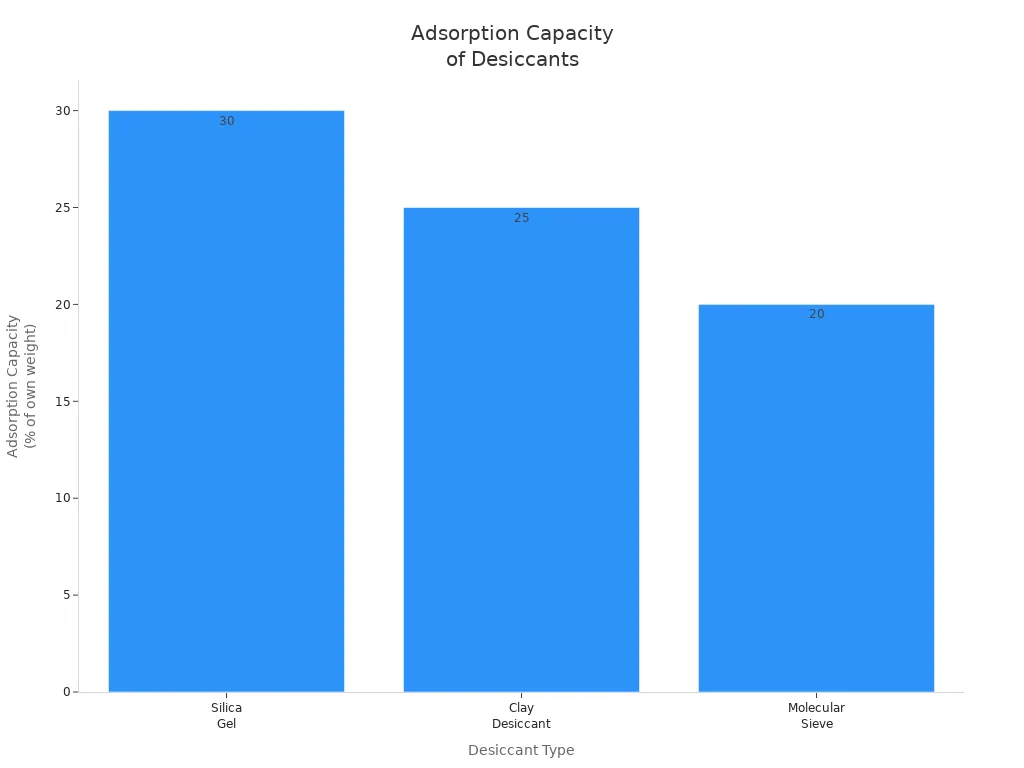
Desiccant Type | RH Range of Peak Efficiency | Adsorption Capacity (at 50% RH, 25°C) | Thermal Stability | Dust Generation |
|---|---|---|---|---|
Silica Gel | 40-70 % RH | ≈ 30 % of its own weight | Up to 149 °C (300 °F) | Very low |
Clay Desiccant | 30-60 % RH | ≈ 25 % of its own weight | Drops sharply above 50 °C (122 °F) | Moderate if crushed |
Molecular Sieve | 0-30 % RH | ≈ 20 % of its own weight (very fast kinetics) | Up to 260 °C (500 °F) | Negligible |
Let’s break down the pros and cons:
Desiccant Type | Advantages | Disadvantages |
|---|---|---|
Silica Gel | Highly adsorbent, stable at high temperatures, safe for food and electronics. | Fills up fast in very humid places, less effective in super dry air. |
Clay | Good for big spaces, cheap, works well in humid areas. | Needs frequent changes, breaks down in heat. |
Molecular Sieve | Grabs moisture quickly, works in very dry spaces, handles high heat. | Costs more, can break down with some chemicals, may not last as long. |
Silica gel is great for electronics and food packaging.
Clay desiccant works best in large, humid storage areas.
Molecular sieve is perfect for places that need ultra-low humidity or high heat.
Choosing the Right Desiccant
You want to pick the best desiccant for your needs. Think about what you are storing and where you are storing it. Here are some things to consider:
Factor | Description |
|---|---|
Type | What kind of desiccant fits your items? |
Working Principle | How does the desiccant absorb moisture? |
Environmental Conditions | Is your space hot, cold, humid, or dry? |
Maintenance Costs | How often do you need to replace the desiccant? |
Automation | Do you want a system that works by itself? |
Silica gel works well in places with steady temperatures and high humidity.
Molecular sieve is best for sensitive products that need quick moisture control.
Clay is a good choice if you want something cheap for big spaces.
When you choose a desiccant, look at your product, your packaging, and your environment. Make sure your choice matches your needs for maximum protection.
If you understand how desiccants work and know the types, you can keep your valuables safe from moisture. You get peace of mind and longer-lasting protection.
Special Considerations for Sensitive Items
Electronics and Optics
You need to keep electronics and optics dry. Even a little water can hurt them. Moisture can ruin a camera lens. It can make a phone stop working. The right desiccant helps stop these problems. Use at least 1.2 units for each cubic foot of space. This amount works for cameras and laptops.
Think about these things when packing electronics: the size of the package, how long you will store or ship it, the air inside the container, the packaging materials, and the climate on the way.
Keep desiccants sealed until you use them. Store them in cool, dry places. Only open them when you need to use them. Check each packet for damage before using it. Use older packets first so you do not waste any. When shipping electronics, pack the desiccant tightly. This helps stop moisture during travel.
Tip: Always use a little more desiccant than you think you need. It is safer to have extra than not enough.
Food and Pharmaceuticals
Food and medicine need special care with desiccant. You must follow safety rules to keep people safe. Food-grade desiccant is safe and meets strict standards. Pharmaceutical desiccant must follow FDA, USP, and EU rules. You want to avoid dust and heavy metals.
Here is a table that shows the differences:
Aspect | Pharmaceuticals | Food Storage |
|---|---|---|
Regulatory Compliance | Must meet FDA, USP, EU standards | Less strict rules |
Safety Standards | Non-toxic, low dust, no heavy metals | Focus on soaking up moisture |
Moisture Sensitivity | Needs controlled adsorption rate | Depends on the food type |
Keep desiccant sealed until you use it for food or medicine. Only open the package when you need to add it. Check the packaging for damage. Use the oldest packets first. When shipping, pack the desiccant securely.
Note: Always use the right desiccant for food and medicine. Never use regular desiccant for things people eat or take.
Art and Collectibles
Art and collectibles need extra care to stay safe. Moisture can cause mold, fading, or warping. Keep humidity between 30% and 50%. Use a hygrometer to check humidity often. Put desiccant canisters in special storage boxes. Check the canisters every two or three months. Replace or recharge them if needed.
Here are some steps to protect art and collectibles: use desiccant with temperature control, watch humidity with a hygrometer, change or recharge desiccant often, and reactivate metal canisters in a warm oven and plastic ones in a microwave (follow instructions).
Callout: Desiccant canisters work best when you check them often. If you see moisture, change them right away.
You can keep sensitive items safe by following these steps. Always use the right desiccant and check your storage often. Your electronics, food, medicine, and art will stay dry and protected.
Best Practices for Desiccant Use
Placement and Distribution
You want your desiccant to work as hard as possible. The way you place and spread it inside your container makes a big difference. Here are some steps to help you get the best results:
Choose the right desiccant for your items and the environment. Some products need special types to remove moisture quickly.
Spread the desiccant evenly throughout the container. This helps every part of your space stay dry.
Place packets in the corners. Moisture often collects there first.
Make sure the container is sealed tight. A good seal keeps outside air from getting in and helps with container moisture management.
Do not put desiccant directly on your items. This can cause damage, especially to sensitive things.
Always close the container right after you add the desiccant.
Check the container for cracks or holes that could let in moisture.
Follow the manufacturer’s advice for how much desiccant to use.
Tip: Even a small gap in your container can let in a lot of moisture. Double-check the seal every time.
Monitoring and Replacement
Desiccant does not last forever. You need to keep an eye on it to make sure it keeps working. Here’s how you can stay on top of container moisture control:
Check desiccant bags often for damage or signs they are full.
Look for color changes if your desiccant has an indicator. When the color changes, it’s time to replace or recharge.
In most cases, you should replace desiccant every 6 to 12 months. If you live in a humid place or store items in tough conditions, you may need to change it more often.
For special dryers, like heated ones, replacement might be needed every two to three years. Heatless dryers can last three to five years.
Always keep extra desiccant sealed until you need it.
Note: Regular checks help you spot problems before they damage your valuables.
Common Mistakes to Avoid
It’s easy to make mistakes with desiccant, but you can avoid them if you know what to watch for:
Using too little desiccant for a big or leaky container. Always use enough to cover the space.
Forgetting about the climate. If your items travel through humid areas, the desiccant will fill up faster.
Picking the wrong type. Not all desiccants work the same way. For example, calcium chloride can turn into a liquid brine.
Thinking desiccant lasts forever. It will get full and stop working if you do not replace it.
Storing spare desiccant packs in the open. Always keep them sealed until you use them.
Not understanding color indicators. Each brand uses different colors to show when the desiccant is full.
Mistake | How to Avoid It |
|---|---|
Too little desiccant | Use the right amount for your space |
Wrong type | Match desiccant to your items |
Ignoring climate | Add more for humid conditions |
Not replacing on time | Set a schedule for checks and changes |
Callout: Good container moisture control starts with the right habits. Check, replace, and store your desiccant the smart way.
By following these best practices, you can keep your items safe and dry. Desiccant works best when you use it correctly and pay attention to the details.
Troubleshooting Desiccant Amount
Signs of Insufficient Desiccant
Sometimes, your things might still feel wet after adding desiccant. This can happen for a few reasons. Maybe you did not use enough desiccant. Your container might let in too much air. Here are some signs that show you need more desiccant:
You notice foggy or wet spots inside the box.
Electronics or collectibles feel sticky or smell musty.
Food or medicine looks clumpy or has mold.
Desiccant packets feel heavy or change color if they have an indicator.
Humidity cards show high moisture inside.
Tip: If you see any of these problems, fix them quickly. Moisture can harm your things in just a few days.
Adjusting for Persistent Moisture
If you keep finding moisture, you should change your desiccant plan. First, check how much desiccant you use. Make sure it matches your container size, item type, and humidity. Sometimes, you need more than the basic rule says.
Here is a simple plan to help with moisture:
Figure out the right amount of desiccant for your box and items.
Look for cracks or leaks in your container.
Put desiccant where air moves well, like corners or near vents.
Pack your items so air can flow around them. Do not pack too tightly.
Seal your container as tightly as you can.
Use humidity cards to watch moisture inside.
You can use different ways to find out how much desiccant you need. Check this table for some choices:
Method | Description |
|---|---|
Use 5-10% of your product’s weight to decide how much desiccant to add. | |
Volume-Based Calculation | Figure out the space inside your container. This works well for odd shapes. |
Moisture Sorption Charts | Use charts to see how much desiccant you need for different humidity levels. |
Here are some formulas you can try:
Calculation Method | Formula |
|---|---|
Weight-Based | Desiccant Quantity (grams) = Product Weight (grams) × Desiccant Percentage |
Volume-Based | Desiccant Quantity (grams) = Container Volume (cm³) × Desiccant Capacity (grams/cm³) |
Moisture Sorption Chart | Find your humidity level on the chart and read the matching desiccant capacity value. |
Note: Always round up when you figure out desiccant. It is better to use a little extra than not enough.
If you follow these steps, you can stop moisture from hurting your things. Keep checking your desiccant and change it when needed. This way, your valuables stay safe and dry.
You can keep your things safe by doing a few easy things. First, measure your box and see how humid it is. Use enough desiccant to fill empty spots and spread it around. Always pick the right desiccant for your stuff and where you store it. Here’s a simple checklist:
Check if your items need extra protection from moisture.
Look at how humid and warm or cold your space is.
Pick packaging that keeps moisture out.
Make sure your desiccant lasts long enough.
Best Use | Storage Tip | |
|---|---|---|
Silica Gel | Works in medium humidity | Keep in a cool, dry spot |
Molecular Sieves | Good for tough places | Needs steady temperature |
Clay-based Desiccants | Fills up fast | Use with tight containers |
Go over these steps each time you store something. Using the right desiccant gives you the best protection.