



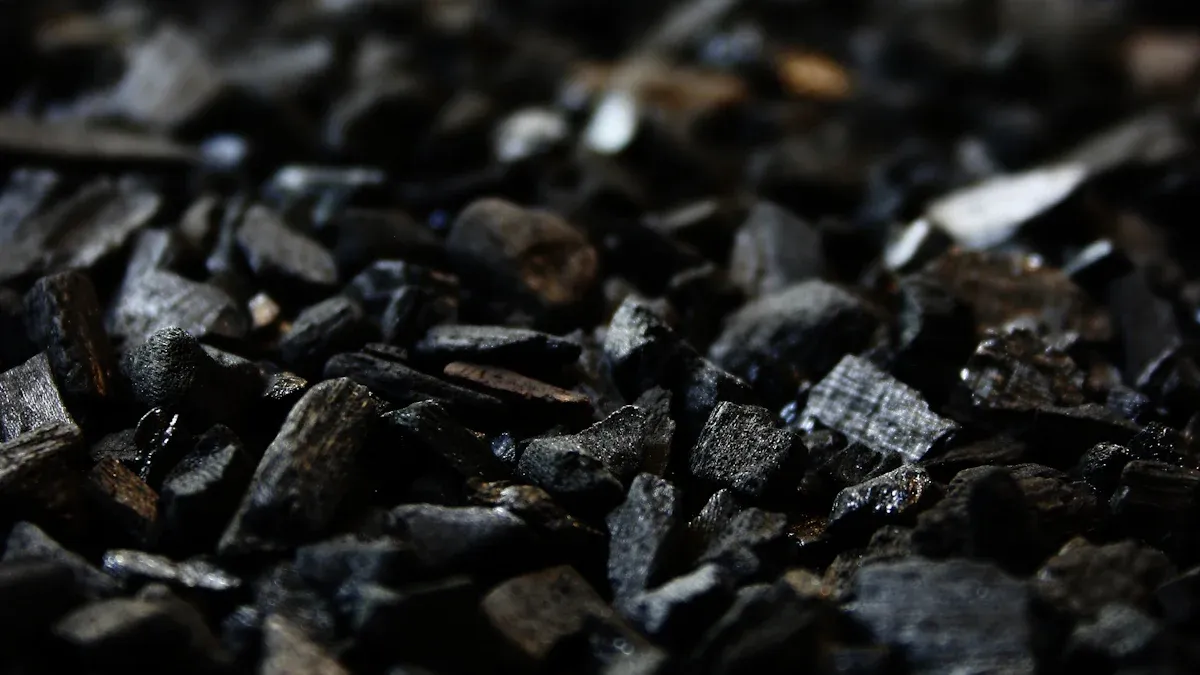
Vous vous demandez peut-être pourquoi le charbon actif imprégné d'hydroxyde fonctionne si bien. Au départ, il s'agit d'un charbon actif ordinaire. Les experts le traitent avec de l'hydroxyde de sodium. Ce traitement modifie son comportement et son aspect. Le charbon actif ordinaire utilise de minuscules trous pour piéger certaines substances. L'hydroxyde de sodium donne au carbone de nouveaux types de trous. Ces nouveaux trous permettent de mieux capter certains polluants. Les métaux lourds et les gaz peuvent être saisis plus facilement. Le matériau dure également plus longtemps. Il est donc idéal pour des utilisations environnementales particulières.
Principaux enseignements
Imprégné d'hydroxyde de sodium charbon actif capte les polluants mieux que le charbon actif ordinaire. Il élimine bien les métaux lourds et les gaz acides.
Le processus commence par le trempage charbon actif dans de l'hydroxyde de sodium. Cette étape permet de capturer davantage de contaminants. La modification de la quantité d'hydroxyde de sodium peut améliorer l'efficacité de l'appareil.
Ce carbone spécial est utilisé de multiples façons. Il aide à purifier l'eau potable et l'air. Il élimine les substances nocives et rend les lieux plus sûrs.
La sécurité est très importante lors de l'utilisation de l'hydroxyde de sodium. Portez toujours un équipement de sécurité. Respectez les règles de mise au rebut. Cela permet de préserver votre sécurité et celle de l'environnement.
L'utilisation de charbon actif imprégné d'hydroxyde de sodium améliore le fonctionnement des systèmes d'épuration de l'eau et de l'air. Il les rend plus résistants à la pollution.
Charbon actif imprégné d'hydroxyde Vue d'ensemble
Qu'est-ce que c'est ?
Charbon actif imprégné d'hydroxyde est un type particulier de carbone. Il est utilisé pour purifier l'air et l'eau. Le charbon actif ordinaire comporte de nombreux petits trous. Ces trous lui donnent une grande surface. Lorsque vous le traitez avec de l'hydroxyde de sodium, il se modifie. L'hydroxyde de sodium ajoute de nouveaux éléments chimiques à la surface. Ces nouveaux éléments permettent de piéger davantage de polluants. Cela fonctionne bien pour les gaz et les métaux lourds.
Le charbon actif imprégné d'hydroxyde ressemble au charbon actif normal. La principale différence réside dans la manière dont il est fabriqué. Il contient également des produits chimiques différents à sa surface. Le charbon actif ordinaire est fabriqué par voie sèche. Le charbon actif imprégné d'hydroxyde utilise une méthode de mélange humide. Le charbon est trempé dans une solution d'hydroxyde de sodium. Ce processus humide modifie sa structure et ses propriétés.
Voici une comparaison rapide entre le charbon actif ordinaire et le charbon actif imprégné d'hydroxyde :
Le charbon actif ordinaire a une surface plus importante, environ 2304 m²/g.
Le charbon actif imprégné d'hydroxyde présente une surface plus faible, de l'ordre de 1141 m²/g.
Les deux types ont des groupes fonctionnels similaires, mais le traitement à l'hydroxyde de sodium offre de nouvelles capacités pour capturer certains polluants.
Comment est-elle fabriquée ?
Vous faire du charbon actif imprégné d'hydroxyde en le trempant dans une solution d'hydroxyde de sodium. Cette étape est appelée imprégnation. Vous pouvez utiliser différentes quantités d'hydroxyde de sodium. La fourchette habituelle est la suivante 6.25% à 50%. Les choix les plus courants sont 6.25%, 12.5%, 25% et 50%. La quantité dépend de ce que vous voulez que le carbone fasse.
Voici les étapes de base de la fabrication du charbon actif imprégné :
Tremper le charbon actif dans une solution d'hydroxyde de sodium.
Utilisation trempage ou pulvérisation pour aider le carbone à absorber l'hydroxyde de sodium.
Sécher le carbone après le trempage.
Chauffez le carbone à 150-200 °C. Cela permet à l'hydroxyde de sodium de se lier au carbone et de mieux fonctionner.
L'imprégnation peut se faire avant ou pendant le chauffage. Le moment de l'imprégnation modifie l'efficacité du charbon. Si vous utilisez trop d'hydroxyde de sodium ou si vous laissez tremper trop longtemps, vous risquez d'endommager les pores. Les pores peuvent s'effondrer et la surface peut se réduire. Si vous utilisez la bonne quantité, vous obtiendrez plus de pores. Cela permet au carbone de mieux piéger les polluants.
En ajoutant de l'hydroxyde de sodium, on obtient plus d'activateurs pour la réaction. Cela permet d'améliorer la structure des pores.
Si vous continuez à ajouter de l'hydroxyde de sodium, la surface peut diminuer. Une trop grande quantité peut nuire à la structure du carbone.
Le bon équilibre permet de fabriquer du charbon actif imprégné d'hydroxyde avec de fortes capacités d'adsorption.
Le charbon actif imprégné d'hydroxyde est spécial car vous pouvez contrôler ses propriétés. Vous choisissez la concentration, le temps de trempage et le processus de chauffage. Vous pouvez ainsi adapter le charbon à vos besoins. Il est utile dans de nombreux domaines, comme la purification de l'eau et l'élimination des gaz nocifs.
Effets de l'imprégnation au NaOH
Changements chimiques
Lorsque le charbon actif est traité avec de l'hydroxyde de sodium, il subit d'importantes modifications chimiques. L'hydroxyde de sodium réagit avec le carbone et décompose certaines de ses parties. Pendant le chauffage, l'hydroxyde de sodium élimine l'eau du charbon. Cela renforce le carbone et empêche la formation de substances telles que le goudron, l'acide acétique et le méthanol. Il en résulte un matériau plus propre et plus stable.
L'hydroxyde de sodium modifie également la surface du carbone. Il ajoute plus de sites actifs où les polluants peuvent s'accrocher. Après le traitement, il y a moins de groupes hydroxyles, mais de nouveaux groupes tels que C≡C et C-N apparaissent. Ces nouveaux groupes aident le carbone à capturer davantage de produits chimiques. Les modifications chimiques rendent le carbone plus apte à piéger de nombreux polluants.
L'hydroxyde de sodium et le carbone réagissent de manière complexe.
Il décompose les matières cellulosiques contenues dans le carbone.
L'hydroxyde de sodium élimine l'eau et renforce le carbone.
Ce processus empêche la formation de goudron et d'autres substances indésirables.
Les nouveaux groupes à la surface aident le carbone à piéger davantage de produits chimiques.
Changements physiques
Après le traitement à l'hydroxyde de sodium, le carbone a un aspect et une texture différents. C'est la texture et la densité qui changent le plus. Lorsque l'on ajoute de l'hydroxyde de sodium, le carbone devient plus lourd. Ce poids supplémentaire peut réduire la quantité d'azote dans les plus petits pores. Même si la surface change, la structure principale des pores reste pratiquement la même. Le réseau de pores petits et moyens subsiste, de sorte que le carbone continue à bien piéger les polluants.
La taille des particules de carbone change légèrement. La taille des particules de carbone change un peu. la taille moyenne est d'environ 89 nanomètres, L'indice de polydispersivité est de 0,765, de sorte que la plupart des particules ont à peu près la même taille. L'indice de polydispersion est de 0,765, ce qui signifie que la plupart des particules ont à peu près la même taille.
Remarque : le carbone reste solide après le traitement à l'hydroxyde de sodium. Il peut encore faire face à des travaux difficiles.
Propriété | Charbon actif ordinaire | Charbon actif imprégné |
|---|---|---|
Taille moyenne des particules | ~88 nm | ~89 nm |
Indice de polydispersivité | - | 0.765 |
Densité | Plus bas | Plus élevé (à cause du NaOH) |
Structure des pores | Intact | En grande partie intacte |
Propriétés d'adsorption améliorées
Charbon actif imprégné piège beaucoup mieux les polluants. Les changements chimiques et physiques l'aident à capter davantage de produits chimiques. Les nouveaux groupes à la surface l'aident à capter plus de types de produits chimiques, en particulier les gaz acides comme le dioxyde de carbone.
Traitement à l'hydroxyde de sodium ajoute plus de sites actifs pour l'adsorption.
Le charbon actif imprégné capture mieux les gaz acides comme le CO2 que le charbon non traité.
Vous pouvez modifier la quantité d'hydroxyde de sodium pour obtenir les meilleurs résultats.
Les l'adsorption de CO2 la plus élevée se produit à 1 M NaOH.
Le charbon actif imprégné peut être utilisé à de nombreuses fins. Il permet d'éliminer les métaux lourds, de nettoyer l'eau et de capturer les gaz nocifs présents dans l'air. Sa meilleure adsorption en fait un excellent choix pour les problèmes environnementaux difficiles.
Conseil : Pour obtenir les meilleurs résultats, choisissez la bonne quantité d'hydroxyde de sodium et le bon temps de trempage. Vous obtiendrez ainsi l'adsorption la plus élevée possible en fonction de vos besoins.
Utilisations du charbon actif imprégné
Purification de l'eau potable
Le charbon actif imprégné contribue à rendre l'eau plus sûre. Il piège de nombreux éléments nocifs dans l'eau potable. L'hydroxyde de sodium modifie la surface du carbone.. Cela lui permet de mieux capturer les contaminants organiques. Par exemple, il élimine le phénol de l'eau. Le phénol est une impureté courante. Si vous êtes préoccupé par les métaux lourds ou l'arsenic, ce charbon aide à les éliminer. Il retient les polluants que le charbon ordinaire pourrait manquer. Vous obtenez ainsi une eau plus propre à boire.
Conseil : pour améliorer votre filtre à eau domestique, choisissez un filtre à charbon actif imprégné. Ces filtres vous protègent des produits chimiques dangereux.
Élimination de l'air et du CO2
Charbon actif imprégné aide à purifier l'air. Il peut être utilisé dans les maisons, les écoles et les usines. Il piège les gaz acides comme le dioxyde de carbone mieux que le charbon non traité. Si vous devez éliminer des odeurs ou des gaz nocifs, ce charbon agit rapidement. Il capture les polluants de l'air et les retient dans ses pores. Vous obtenez un air plus frais et un lieu plus sûr.
Le charbon actif imprégné est utilisé dans les purificateurs d'air pour capter le CO2 et d'autres gaz.
Il aide à contrôler les odeurs et à garder l'air intérieur propre.
Applications industrielles
Les industries utilisent le charbon actif imprégné pour résoudre les problèmes de pollution. Il permet d'assainir l'eau et l'air dans de nombreux endroits. Les usines l'utilisent pour traiter les eaux usées et éliminer les gaz toxiques. Voici un tableau présentant les principaux secteurs d'activité et comment ils utilisent ce carbone :
Secteur industriel | Cas d'utilisation typiques |
|---|---|
Stations d'épuration des eaux usées | Contrôle des gaz toxiques ou malodorants, comme le sulfure d'hydrogène et les mercaptans. |
Usines de pâte à papier | Élimination des gaz légers et contrôle des mauvaises odeurs. |
Usines chimiques | Traitement des eaux usées, adsorption des polluants tels que les composés aromatiques et les solvants chlorés. |
Fabrications de fils en caoutchouc | Adsorption des polluants dans le traitement des eaux usées. |
Teinture des tissus | Traitement des déchets contenant des colorants et d'autres contaminants. |
Usines d'engrais | Élimination des polluants des eaux usées. |
Usines de pâte à papier | Traitement des déchets, y compris l'adsorption des phénols et des dérivés hydroxylés. |
Le charbon actif imprégné aide à éliminer les métaux lourds et l'arsenic de l'eau dans ces industries. Il contribue à la purification de l'eau et du gaz à grande échelle. Il joue donc un rôle important dans la préservation de la propreté de notre environnement.
Avantages et sécurité
Principaux avantages
Charbon actif imprégné d'hydroxyde de sodium présente de nombreux avantages. Il élimine plus de polluants que le charbon actif ordinaire. Vous pouvez l'utiliser pour mieux purifier l'eau et l'air. Le charbon retient les métaux lourds, les gaz acides et les produits chimiques organiques. Il dure plus longtemps et ne s'use pas rapidement. Il n'est pas nécessaire de le remplacer souvent. Vous pouvez modifier le niveau d'hydroxyde de sodium en fonction de vos besoins. Il est donc utile pour de nombreux problèmes environnementaux.
Conseil : Choisissez le charbon actif imprégné d'hydroxyde de sodium pour les tâches difficiles. Il est efficace pour éliminer l'arsenic ou stopper les mauvaises odeurs dans les grands espaces.
Lignes directrices en matière de sécurité
Vous devez faire preuve de prudence lorsque vous utilisez du charbon actif imprégné d'hydroxyde de sodium. L'hydroxyde de sodium peut blesser la peau et les yeux. Vous devez porter un équipement de sécurité pour vous protéger. Le tableau ci-dessous indique ce dont vous avez besoin dans les laboratoires et les usines :
Catégorie | Recommandations |
|---|---|
Yeux/Face | Porter des lunettes de protection étanches contre les éclaboussures de produits chimiques et un écran facial en cas d'éclaboussures. |
Peau/Corps | Utilisez une combinaison résistante aux produits chimiques et des bottes en caoutchouc. Ne pas utiliser de cuir car il se dégrade. |
Mains | Portez des gants résistants aux produits chimiques qui montent jusqu'au poignet. |
Respiratoire | Utilisez un respirateur si vous risquez d'en respirer trop. |
Général | Garder propre. Ne pas manger, boire ou fumer pendant l'utilisation de ce matériel. |
Mesures d'urgence | En cas d'ingestion, rincer la bouche et boire de l'eau. En cas de contact avec les yeux, les rincer pendant 15 minutes. |
Lavez-vous toujours les mains après avoir utilisé ce produit. Tenir les aliments et les boissons à l'écart de la zone de travail. Si l'hydroxyde de sodium entre en contact avec la peau ou les yeux, rincez-les immédiatement à l'eau.
Manipulation et élimination
Vous devez respecter des règles lorsque vous jetez du charbon actif imprégné d'hydroxyde de sodium. Le charbon usagé peut contenir des produits chimiques dangereux. Vous devez :
Déposer le carbone usagé dans une décharge qui accepte les déchets dangereux.
Ne le brûlez pas et ne le jetez pas à l'égout.
Vérifiez les règles locales avant de vous en débarrasser.
Remarque : le fait de jeter les déchets de la bonne manière permet de protéger les personnes, les animaux et l'environnement.
Le charbon actif imprégné d'hydroxyde de sodium permet de piéger davantage de polluants. Vous pouvez l'utiliser pour nettoyer l'eau et l'air. Il permet également de résoudre les problèmes de dureté dans les usines. De nouvelles méthodes utilisent les coques de noix de coco et les coques de palmiste pour fabriquer du charbon actif. Il s'agit de matériaux naturels qui contribuent à la protection de l'environnement. L'hydroxyde de sodium produit des sous-produits plus sûrs, Le processus est donc meilleur pour la nature.
La modification de la surface permet de capter davantage de polluants.
L'utilisation de plantes rend le processus plus respectueux de la planète.
Avancement | Description |
|---|---|
Il élimine mieux le sulfure d'hydrogène et d'autres gaz. | |
Matériaux à surface élevée | Ils permettent de nettoyer les gaz plus efficacement. |
Imprégnants alcalins | Ils aident à se débarrasser des gaz toxiques comme le sulfure d'hydrogène. |
Vous devez toujours être prudent et respecter les règles de sécurité lorsque vous utilisez ce matériau. Le charbon actif imprégné d'hydroxyde de sodium contribue à la propreté de l'air, de l'eau et des usines.