



When you use Активированный уголь для очистки воды, it traps contaminants by adsorption. Water treatment activated carbon grabs things you do not want, like chlorine, chloramines, and organic compounds. Research shows that Water Treatment Activated Carbon removes haloacetic acids, trihalomethanes, and other by-products effectively:
Тип загрязнителя | Effectiveness of Water Treatment Activated Carbon |
|---|---|
Haloacetic Acids (HAAs) | Removes well during chlorination |
Trihalomethanes (THMs) | Removes well during chlorination |
Disinfection By-Products (DBPs) | Lowers amounts and toxic effects a lot |
Water treatment activated carbon filters help water taste and smell better. Many water plants use Water Treatment Activated Carbon to get rid of bad compounds. Granular activated carbon takes out organic pollutants and odors. This makes water safer and nicer to drink. You get cleaner water and better purification when you use these filters.
Основные выводы
Activated carbon cleans water by trapping bad stuff. This happens through a process called adsorption.
It removes chlorine, chloramines, and organic compounds. This makes water taste and smell better.
Granular activated carbon filters are used in water treatment plants. They help make water cleaner.
Activated carbon has a big surface area. This lets it catch more unwanted things.
Change your activated carbon filter every 3 to 6 months. This keeps it working well.
Portable activated carbon filters help you get safe water. You can use them when camping or traveling.
Activated carbon does not remove heavy metals or bacteria. You should use other filters for those.
Pick filters made from renewable materials. This helps keep water treatment good for the planet.
Активированный уголь для очистки воды
Activated carbon is important in cleaning water. People use it to take out bad stuff and make water better. Activated carbon grabs and holds onto things that should not be in water. This makes water safer for drinking and using every day.
Процесс адсорбции
Activated carbon cleans water by adsorption. Adsorption means tiny things in water stick to the carbon’s surface. This helps because the bad stuff leaves the water and stays on the carbon.
Пористая структура
Activated carbon has lots of tiny holes inside it. These holes work like traps for unwanted things. When water goes through, the holes catch things you do not want. The size and shape of the holes decide what gets trapped. You get cleaner water when the holes fit the size of the bad stuff.
Adsorption is when small things in water stick to activated carbon.
Activated carbon has a huge surface area, about 1,000 square meters for each gram.
The way the holes are spread out in activated carbon matters. They pick which things can be trapped, so it works for many kinds of bad stuff.
Площадь поверхности
Activated carbon works well because it has a big surface area. One gram of activated carbon can have up to 1,000 square meters of surface. This gives more places for bad stuff to stick. Using activated carbon means you can trap more unwanted things in your water.
Types of Contaminants
Activated carbon takes out many kinds of bad things from water. You can see how it works for different stuff in the table below:
Тип загрязнителя | Описание |
|---|---|
Органические соединения | Includes things like pesticides and other chemicals |
Metals | Some metals can be taken out, especially those stuck to organic stuff |
Радон | Activated carbon can remove radon well |
Хлор | Activated carbon removes chlorine easily |
Heavy Metals | It can take out some heavy metals |
Органические соединения
Organic compounds come from things like pesticides, factories, or nature. Activated carbon traps these by adsorption. This helps keep harmful chemicals out and makes water cleaner.
Chlorine and Chloramines
Water plants add chlorine or chloramines to kill germs. These can make water taste and smell weird. Activated carbon takes out chlorine and chloramines, so your water tastes and smells better.
Taste and Odor Compounds
Sometimes water tastes or smells strange. Activated carbon helps by trapping the things that cause these problems. You will notice your water tastes and smells much better after using activated carbon.
Tip: If you want cleaner water at home, pick filters with activated carbon. They help take out lots of bad stuff and make water better.
Что такое активированный уголь
Определение
Activated carbon is special for cleaning water. It is made from carbon that has lots of tiny holes. These holes help it grab and hold bad stuff in water. When you use activated carbon, you can take out many unwanted things. Your water tastes better and smells nicer. This material can soak up lots of different things. It is a good choice because it works well and does not cost too much.
Takes out many bad things from water
Makes water taste and smell better
Note: Activated carbon is also called activated charcoal. Both names mean the same thing when cleaning water.
Production Methods
Сырьевые материалы
Activated carbon comes from things like coconut shells, wood, peat, or coal. These things have natural carbon inside them. Companies pick these materials because they make strong and hole-filled activated carbon.
Activation Techniques
To make activated carbon, you need to activate the raw materials. This means using heat or chemicals to open up tiny holes. There are two main types used for cleaning water:
Гранулированный активированный уголь (GAC): GAC is used in columns. Water moves through the carbon and loses bad stuff. You can clean GAC by heating it, but sometimes you need new carbon.
Порошкообразный активированный уголь (PAC): PAC is put right into water. It works well for getting rid of toxic things. PAC is easy to make, but you often need fresh carbon because it is hard to clean.
Properties for Water Treatment
Activated carbon is different from other filters because of its special features. These features help it clean water very well.
Недвижимость | Описание |
|---|---|
Пористая структура | Activated carbon has lots of tiny holes that trap bad stuff. |
Large Surface Area | The big surface lets more bad things stick to the carbon. |
It takes out many kinds of bad things, like chlorine and VOCs. | |
Твердость | Strong pieces do not break easily, so the filter lasts longer. |
Adsorption Properties | It can grab lots of bad stuff quickly and well. |
Низкое содержание золы | Less ash means better quality and better cleaning. |
Значение pH | The pH can change how well activated carbon grabs bad stuff. |
When you pick activated carbon for cleaning water, you get something strong and useful. It works fast and can clean many kinds of water. You can trust it to give you safer and cleaner water at home or work.
Activated Carbon Filters
Home Filtration
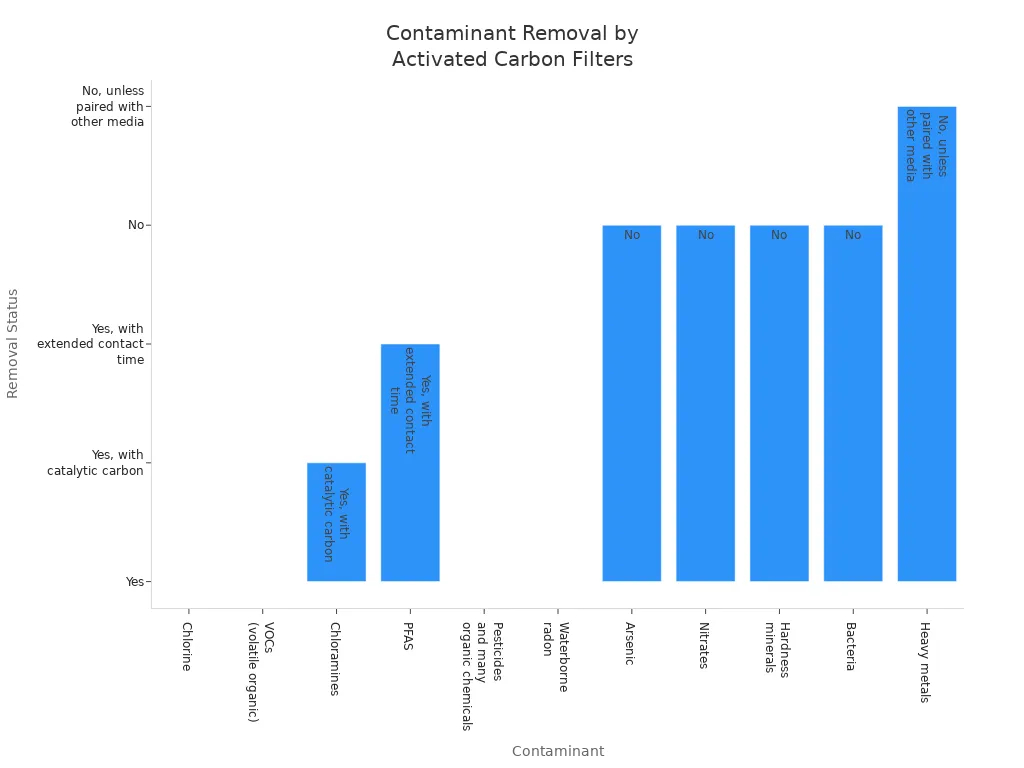
Activated carbon filters help make your water at home safer. You can find these filters in pitchers, on faucets, or under sinks. When water moves through the filter, activated carbon catches many bad things. Your water tastes and smells better right away. Most filters at home remove chlorine, VOCs, chloramines, and pesticides. Some special filters can also help with PFAS if water stays longer in the filter. But activated carbon does not take out minerals that make water hard, bacteria, or heavy metals unless you use other filters too.
Here is a table that shows what activated carbon filters can remove in home water systems:
Загрязнитель | Removed by carbon filter |
|---|---|
Хлор | Да |
ЛОС | Да |
Chloramines | Yes, with catalytic carbon |
PFAS | Yes, with extended contact time |
Pesticides and organic chemicals | Да |
Waterborne radon | Да |
Мышьяк | Нет |
Nitrates | Нет |
Hardness minerals | Нет |
Бактерии | Нет |
Тяжелые металлы | No, unless paired with other media |
Tip: To get better tasting water at home, pick filters with activated carbon. These filters help lower chemicals in your water.
Municipal Systems
Cities use activated carbon filters in big water plants. These filters help meet rules for clean water. You get cleaner water because activated carbon takes out organic compounds, chlorine, and other bad things. Cities use large beds and columns filled with granular activated carbon. Sometimes, they use these filters with reverse osmosis or ion exchange for extra cleaning. Emergency teams use mobile activated carbon filters to fix problems like PFAS fast.
Here is how activated carbon helps in city water systems:
Приложение | Описание |
|---|---|
Водоочистные станции | Removes organic compounds, chlorine, and contaminants to meet quality standards. |
Очистка сточных вод | Cleans industrial water before releasing it into the environment. |
PFAS Removal | Uses granular activated carbon to protect public health. |
Large filter beds in water plants
Granular activated carbon columns used with other methods
Note: Cities depend on activated carbon filters to keep your water safe and fresh.
Промышленное использование
Factories use activated carbon filters to clean water for many jobs. These filters are found where solvents, pesticides, and other chemicals need to be removed. Activated carbon traps both organic and inorganic contaminants. It also helps take out chlorine and some heavy metals. In drinking water treatment, activated carbon makes water safer and better. In seawater desalination, it protects machines by removing things that cause bad smells, leftover chlorine, and dissolved organic compounds.
Activated carbon filters catch non-polar organic compounds, ionic species, and organic molecules.
You see these filters in drinking water treatment and seawater desalination.
These filters protect equipment and make water better.
Tip: Factories use activated carbon filters because they work quickly and remove many kinds of contaminants.
Portable Filters
You can use portable activated carbon filters when you are not at home. These filters help you get safe water while camping or hiking. You also use them when you travel. You find these filters in water bottles, pump filters, and straw filters. They work by trapping chemicals you do not want. They also make water taste better. You do not need power or plumbing to use them. Just fill your bottle or pump water through the filter.
Portable activated carbon filters take out chlorine, chloramines, and VOCs. They also help water taste and smell better. You can use them for water from lakes, rivers, or taps. This is good if you worry about water quality. These filters do not remove every contaminant. But they help with many common problems.
Here is a table that shows how portable activated carbon filters compare to home and city systems:
Filter Type | Effectiveness in Contaminant Removal |
|---|---|
Portable Activated Carbon Filters | |
Home Systems | Often use activated carbon with reverse osmosis or KDF |
Municipal Systems | Usually have many filtration methods for more removal |
You can see that portable activated carbon filters work for some chemicals. Home and city systems can remove more types of contaminants. Portable filters help make water safer and taste better when you are away from home.
Here is a quick list of what portable activated carbon filters do:
Removes chlorine
Removes chloramines
Removes VOCs
Makes water taste and smell better
Portable activated carbon filters do not remove bacteria, viruses, or heavy metals. If you need to treat water with these, you must boil it or use another filter. Portable filters give you a fast way to make water better in many places.
You can carry portable activated carbon filters in your backpack or emergency kit. They are light and simple to use. You do not need special skills to use them. Many people use these filters for outdoor trips, travel, or emergencies.
Tip: Always read the instructions for your portable activated carbon filters. Change the filter when it gets old or clogged. This keeps your water clean and safe.
Portable activated carbon filters help you feel safe when you drink water away from home. You get better taste and fewer chemicals. You can enjoy your activities without worrying about water quality.
Contaminant Removal Mechanisms
When you use активированный уголь, it removes bad stuff in two ways. These ways are called физическая адсорбция and chemical adsorption. Both help make water cleaner and safer.
Физическая адсорбция
Physical adsorption happens when molecules stick to activated carbon. No chemical reaction is needed for this to work. Activated carbon has lots of tiny holes and a big surface. This helps it trap things you do not want. Physical adsorption works best for organic compounds like pesticides and VOCs.
Some main things about physical adsorption are:
Molecules stick to the surface with weak forces called Van der Waals forces.
You can sometimes clean and reuse activated carbon because this process is reversible.
Physical adsorption works well at low temperatures.
Activated carbon grabs many contaminants as water passes over it.
Tip: Physical adsorption takes out chemicals from water without changing them.
Химическая адсорбция
Chemical adsorption uses stronger forces to trap bad stuff. Molecules make chemical bonds with activated carbon in this process. Chemical adsorption happens when activated carbon removes chlorine and chloramines. These reactions turn contaminants into safer forms.
Вот table that shows how physical and chemical adsorption are different:
Характеристика | Физическая адсорбция | Химическая адсорбция |
|---|---|---|
Forces | Weak Van der Waals forces | Strong valence bond forces |
Reversibility | Reversible | Irreversible |
Тип процесса | Endothermic | Exothermic |
Activation Energy | Low temperature required | Higher energy involved |
Adsorption Heat | Small | Significant |
Механизм | Molecular attraction | Formation of chemical bonds |
Activated carbon also uses catalytic reduction to get rid of chlorine compounds. When you treat water, you see reactions like these:
C* + NH2Cl + H2O → NH3 + H+ + Cl- + C*O
CO + 2NH2Cl → C + 2H+ + 2Cl- + H2O + N2
These reactions help remove chlorine and chloramines. Your water tastes and smells better after this. Activated carbon can also break down other chemicals in similar ways.
Note: Chemical adsorption is important for taking out disinfectants and making water safer to drink.
Факторы, влияющие на производительность
Some things change how well activated carbon works. These things can affect how much bad stuff gets removed.
Contact Time
Contact time means how long water touches activated carbon. If water moves slowly, there is more time for adsorption. Longer contact time helps trap more contaminants. If water moves fast, less gets removed.
Температура
Temperature can change how well activated carbon works. Higher temperatures can make molecules move faster. But sometimes, higher temperatures lower adsorption. Most systems work best at room temperature. You do not need to heat water for activated carbon to work.
pH
The pH of water changes how activated carbon traps contaminants. Lower pH usually helps adsorption. If water is too acidic or too basic, activated carbon may not work as well. You can check your water’s pH to see if your filter will work best.
Here is a table that shows what affects activated carbon performance:
Фактор | Описание |
|---|---|
Nature of activated carbon | Surface area, pore size, and strength decide how well it works. |
Properties of pollutants | Size, shape, and concentration of contaminants matter. |
Solution pH | Lower pH often helps adsorption. |
Solution temperature | Temperature changes can affect how much gets trapped. |
Coexistence of multiple adsorbates | Many pollutants together can lower how much each gets removed. |
Operational conditions | Contact time and filter type change how well activated carbon works. |
Tip: You can help your filter work better by letting water move slowly and checking the pH.
Activated carbon is a strong way to clean water. You get better results when you know how adsorption works and what things matter most.
Преимущества и ограничения
Преимущества
Эффективность
Activated carbon is great for cleaning water. It takes out many chemicals and makes water better. Adsorption helps activated carbon trap chlorine and organic compounds. This makes water taste and smell nicer. You can look at the table to see how it compares to other filters:
Преимущество | Описание |
|---|---|
Chemical Removal | Activated carbon takes out lots of chemicals, like chlorine and organic compounds, so water tastes and smells better. |
Универсальность | It grabs many kinds of contaminants, so it works for different water problems. |
Energy Efficiency | The filter does not need electricity and saves energy. |
Ease of Replacement | You can change filters easily without special tools. |
Activated carbon works in homes, cities, and portable filters. You can use it almost anywhere. It does not need power and is simple to take care of.
Безопасность
Activated carbon is safe for drinking water if you use it right. Most filters are safe, but you should know a few things:
A little carbon dust is okay, but too much dust means your filter might be breaking.
Bacteria can grow if you do not change filters on time.
Activated carbon does not take out everything, like heavy metals or germs.
Tip: Pick filters with certifications from groups like NSF International or the Water Quality Association. Change your filter every 2-6 months, rinse new filters before using, and use more than one filter stage if you want to remove heavy metals or germs.
Ограничения
Saturation
Activated carbon can only hold so much. After a while, the filter fills up and cannot trap more bad stuff. When this happens, the filter does not clean water as well. You may not know when the filter is full, so you should change it often. If water moves too fast, the filter cannot work as well because there is not enough time for adsorption.
You might not notice when the filter is full.
Fast water flow makes the filter less effective.
Incomplete Removal
Activated carbon does not take out every contaminant. Some things, like heavy metals and germs, can get through. Good filters can cost a lot for some people or small water systems. Used filters may need special care if they have dangerous stuff inside. How well the filter works can change depending on what is in the water and how you use it.
Some bad things, like heavy metals and germs, stay in the water.
Getting rid of used filters can be hard if they have dangerous stuff.
The filter works differently based on water quality and how you use it.
Note: Always follow the instructions from the maker for filter care and changing. This helps you get the best results from your activated carbon filter.
Maintenance and Lifespan
Taking care of your activated carbon filter is important. This helps you get clean water every day. You should know when to change your filter. Watch for signs that show it is wearing out. Follow easy cleaning steps to keep it working well.
Замена фильтра
You must change your activated carbon filter often. Most home filters last about six months. Some can last up to a year. Always check the instructions from the maker. If you use lots of water, change the filter sooner. If your water has many contaminants, replace it more often.
Change your filter every 3 to 6 months at home.
Some filters last up to 12 months if they are good.
Always listen to what the maker says for your filter.
Good filters last longer than cheap ones.
More contaminants mean you need to change the filter more.
Фактор | Рекомендация |
|---|---|
Quality of carbon filter | Good filters last longer than cheap ones. |
Contaminant levels | More contaminants mean more changes needed. |
Volume of water filtered | More water means the filter does not last as long. |
Manufacturer’s recommendation | Follow the maker’s advice for when to change your filter. |
Tip: Write down the date when you put in a new filter. This helps you remember when to change it.
Signs of Reduced Performance
You can tell when your activated carbon filter is not working well. Look for these signs to keep your water safe:
Sign of Decline | Описание |
|---|---|
Unpleasant Taste | Water tastes bad or bitter, which means the filter is not working. |
Неприятный запах | Water smells like chlorine or musty, showing the filter is weak. |
Reduced Water Flow | Water comes out slower, so the filter might be clogged. |
Cloudy Water | Water looks cloudy or colored, which means there is a problem. |
Visible Sediment | You see bits in your water, so the filter is worn out. |
If you see any of these problems, change your filter right away.
Note: Clean water should taste good and have no smell. If you notice changes, check your filter.
Maximizing Efficiency
Вы можете help your activated carbon filter last longer by doing simple things. Clean it often and use it carefully.
Stop using the filter and let out any pressure.
Take the filter apart with the right tools.
Brush off dust and dirt or use a vacuum.
Rinse the activated carbon to wash away dirt.
Soak the filter in a safe cleaner if needed.
Rinse again to remove any leftover cleaner.
Let the filter dry all the way before using it.
Put the filter back together and install it.
Tip: Always use clean hands and tools when you touch your filter. This keeps your water safe.
Keeping your filter clean and changing it on time helps it work better. You get safer water and save money by not changing filters too soon.
Тенденции будущего
Technology Advances
New technology is changing how we clean water. Scientists use low-temperature activation with farm waste. This saves energy and helps nature. Factories use carbon sequestration to lower pollution. Advanced adsorption can remove hard contaminants like PFAS. Some new granular activated carbon filters almost remove all PFAS.
Modern factories use coconut shells and bamboo to make carbon. These materials help lower pollution. Microwave activation saves even more energy. Plasma technology changes the carbon’s surface for better cleaning. Filters now pick out heavy metals and tiny pollutants better. Some companies mix activated carbon with nanomaterials. This makes filters stronger and last longer.
Low-temperature activation uses farm waste.
Carbon sequestration lowers pollution.
Advanced adsorption removes PFAS.
Coconut shells and bamboo are used.
Microwave and plasma make better filters.
Nanomaterials help filters last longer.
Sustainable Production
You can help the earth by picking filters made in green ways. Hard coal is a good base for activated carbon. It is easy to find and cheap. Some makers use molasses as glue. Molasses comes from farms and makes carbon stronger. This helps use renewable resources. The best grain size for water treatment is 0.5–2 mm. This size lets water move easily and helps the filter work well. Factories heat carbon to about 800 °C with steam. This makes a product that cleans water and lasts longer.
Tip: Pick filters made with renewable materials and energy-saving steps. These choices help protect nature.
Integration with Other Methods
Water gets cleaner when you use more than one method. Activated carbon works best with other filters. No single filter removes everything. You need a mix for the best results. Some filters target certain contaminants. Others work better together.
Integration Method | Описание |
|---|---|
Competitive Adsorption | Strongly adsorbed contaminants get removed first, which can affect others. |
Combination of Treatment Methods | Using multiple methods gives you more complete water purification. |
Specific Contaminant Removal | Different carbons target different contaminants, so you need a tailored approach. |
Activated carbon removes taste and odor compounds. It also filters out tiny contaminants and PFAS. Its special adsorption makes it important for safe water.
Note: You get the best water by using activated carbon with other cleaning steps.
You can count on water treatment activated carbon to make water better and keep you healthy. When water goes through these filters, they take out chlorine, bad smells, and dangerous chemicals. More people want clean water because rules are stricter and new contaminants show up.
Аспект | Значение |
|---|---|
Размер рынка в 2024 году | |
Estimated Market Size in 2035 | US $7,847.9 million |
If you want to know more about cleaning water, look at advanced filtration or check tips for designing activated carbon systems.