Carvão ativado catalítico

Buy Catalytic Activated Carbon

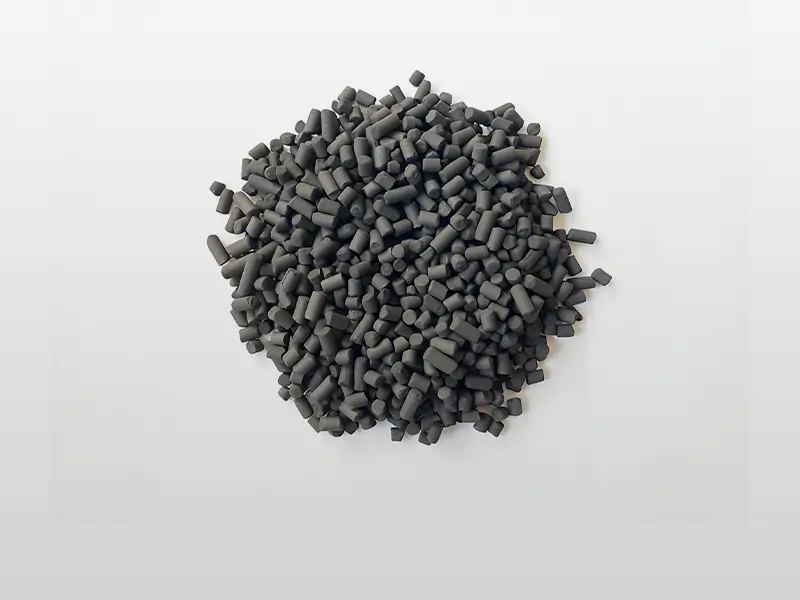
Catalytic Activated Carbon (CAC) is a porous material that possesses both adsorption function and catalytic activity. It is widely applied in various fields such as environmental treatment (desulfurization, denitrification, VOCs treatment), chemical synthesis (catalytic hydrogenation, oxidation reactions), and energy conversion (fuel cells, energy storage).

Desafios do sector

Technical Performance Bottleneck

Engineering Application Challenges

Control of By-products

Challenges of Cutting-edge Technologies

tipos relacionados de carvão ativado

Carvão ativado granular)
  • Valor de iodo: 600-1200
  • Tamanho da malha: 1×4/4×8/8×16/8×30/12×40/20×40/20×50/30×60/40×70 (Mais tamanho a pedido)
  • Densidade aparente: 400-700
Carvão ativado com pilares
  • Valor de iodo: 500-1300
  • Tamanho da malha:0.9-1mm/1.5-2mm/3-4mm/6mm/8mm(Mais tamanho a pedido)
  • Densidade aparente: 450-600
Carvão ativado em pó)
  • Valor de iodo: 500-1300
  • Dimensão da malha: 150/200/300/350 (outras dimensões a pedido)
  • Densidade aparente: 450 - 550
Carvão ativado em favo de mel)
  • Valor de iodo: 400-800
  • Tamanho da malha: 100×100×100mm/100×100×50mm (densidade celular personalizada a pedido)
  • Densidade aparente: 350-450
  • Diâmetro do furo: 1,5-8 mm
  • Valor de iodo: 700-1200 mg/g
  • Área de superfície: 700-1200 m²/g
  • Densidade aparente: 320-550 kg/m³
  • Valor de iodo: 700-1200 mg/g
  • Área de superfície: 700-1200 m²/g
  • Densidade aparente: 320-550 kg/m³
Carvão ativado à base de carvão
  • Valor de iodo: 700-1200 mg/g
  • Área de superfície: 700-1200 m²/g
  • Densidade aparente: 300-650 kg/m³
  • Valor de iodo: 700-1200 mg/g
  • Área de superfície: 700-1200 m²/g
  • Densidade aparente: 320-550 kg/m³
  • Método de ativação: Ativação por vapor/gás a altas temperaturas
  • Estrutura de poros: Microporosa dominada, distribuição uniforme dos poros
  • Perfil ambiental: Sem químicos, baixo teor de cinzas
  • Aplicações principais: Adsorção em fase gasosa, purificação de água potável
  • Método de ativação: Ativação química (por exemplo, H₃PO₄/ZnCl₂) a temperaturas moderadas
  • Estrutura de poros: Mesoporoso-rico, maior área de superfície
  • Eficiência do processo: Tempo de ativação mais curto, rendimento 30-50% mais elevado
  • Pós-tratamento: É necessária uma lavagem com ácido para remover os resíduos
  • Funcionalização: Carregado com agentes activos (por exemplo, I₂/Ag/KOH)
  • Adsorção direcionada: Captura melhorada de poluentes específicos (por exemplo, Hg⁰/H₂S/gases ácidos)
  • Personalização: Quimicamente optimizado para contaminantes alvo
  • Aplicações principais: Tratamento de gases industriais, proteção CBRN

Porquê utilizar o nosso carvão ativado

sketch

Precisely Customized Carrier Solutions:

1. Regarding environmental governance: Develop ultra-large mesoporous AC (with pore diameters ranging from 20 to 100 nm), which perfectly matches large-molecule enzymes such as laccase and peroxidase (enzyme loading > 400mg/g).

2. For medical applications: Ultra-pure medical-grade AC (ash content < 0.1%, no detection of heavy metals), certified by FDA/GMP.

3.For the food industry: Surface inert modification AC prevents the migration of impurities during the enzymatic catalysis process.

advanced (5)

Intelligent Production Control System:

1. AI-driven pore structure optimization: Using machine learning to predict the optimal pore size distribution, ensuring that the fluctuation in enzyme loading is less than ±3%.

2. Digital Twin Factory: The virtual simulation can predict the decline in catalyst performance 48 hours in advance, allowing customers to adjust production parameters in real time.
Processo e tecnologia

1. Metal-supported Catalytic Method

Visão geral da solução

The metal-supported catalytic method involves loading active metal components (such as Pd, Pt, Cu, Fe, etc.) onto the surface of activated carbon. By leveraging the high specific surface area and abundant pore structure of activated carbon, combined with the catalytic activity of the metals, this technique enables efficient catalytic reactions.

Metal-supported catalytic method

Principais vantagens

2. Non-metallic Modified Catalytic Method

Visão geral da solução

The non-metallic modified catalytic method is a technology that endows the surface of activated carbon with catalytic functions through chemical modification or element doping, without relying on precious metals.

Non-metallic modified catalytic method

Principais vantagens

3. Acid-base Catalysis Method

Visão geral da solução

The acid-base catalysis method is a technology that utilizes the acidic or basic functional groups on the surface of activated carbon as catalytic active sites to facilitate chemical reactions.

Acid-base catalysis method

Principais vantagens

4. Light/Electro-catalytic Method

Visão geral da solução

The photo/electro-catalysis method is a cutting-edge technology that combines activated carbon with photosensitive or conductive materials to drive catalytic reactions using external light energy or electrical energy.

Light_Electro-catalytic method

Principais vantagens

5. Biological Enzyme Immobilization Method

Visão geral da solução

The immobilization of biological enzymes involves fixing free enzymes onto activated carbon through physical or chemical methods, thereby creating stable and reusable biological catalysts.

Biological enzyme immobilization method

Principais vantagens

Blogue relacionado

How Does Catalytic Activated Carbon Differ from Regular Activated Carbon
Ler mais
Deslocar para o topo

Obter inquérito

Nome